
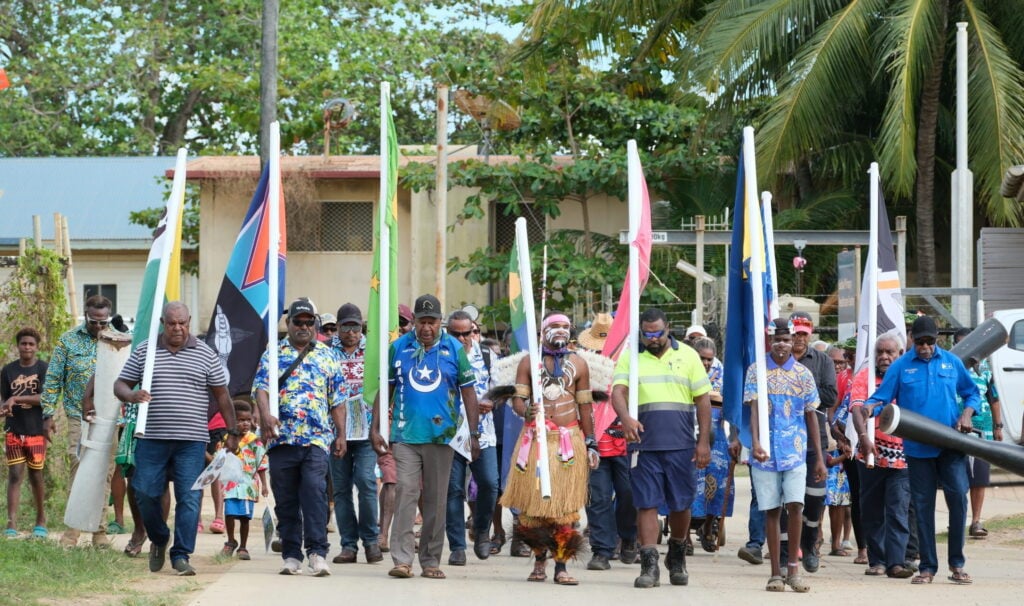
Traditional song, dance and a community march carried celebrations from day to night as the remote island community of Saibai launched its first seasonal calendar – Saibailgaw Mura Zugubaw Thonaral – a landmark cultural achievement years in the making.
Torres Strait Regional Authority (TSRA) Chair George Nona said the project, rich in traditional Kala Kawaw Ya language, was a major step forward for cultural preservation across the community and region.
“United by a shared vision over many years, the project brought together community members in a best-practice approach combining traditional knowledge and western science to protect and preserve Saibailgal culture,” Mr Nona said.
“This calendar is more than a resource, it is a living testament to the identity, resilience and cultural strength of Saibai, its people, land and sea.
“It will ensure that local cultural knowledge held safely for thousands of years is cherished and passed on to future generations.”
Mr Nona said the calendar would also strengthen on‑Country work by equipping local rangers with culturally grounded seasonal indicators.
“The calendar can serve as a long-term cultural learning tool for Saibai families, children, rangers and Torres Strait communities from the island to the mainland.”
The First Nations-led project with Elders, Traditional Owners and community was officially endorsed by the Saibai Mura Buway Registered Native Title Body Corporate (RNTBC).
It was proudly supported by the TSRA Environmental Management Program Land and Sea Management Unit, including Mura Buway Rangers and dedicated Traditional Ecological Knowledge (TEK) team.
The achievement, officially launched on 29 May 2026, was also made possible through the dedication of botanist Dave Fell, a special guest at the event, who was part of the original co-design process with community and the TSRA project team.
In addition, collaboration included a virtual linkup with world‑renowned astronomer Duane Hamacher to verify star constellation and moon phase information, aligning ancient wisdom with global science.
Saibai Mura Buway RNTBC Kuyku Mabayg PBC Chair Kerry Akiba said the cultural milestone strongly respected the community’s past, present and future.
“The calendar captures the way Saibailgal ancestors read the winds, tides, stars, plants, animals, and sea life to understand the seasons,” Mr Akiba said.
“The calendar ensures that traditional ecological knowledge continues to be passed down, protecting language, identity, and cultural practice.
“We acknowledge the Elders, Traditional Owners and language speakers who generously shared their knowledge, stories and cultural authority.
“We also pay tribute to those who are no longer with us, including respected knowledge holders, whose wisdom lives on through this calendar and the contributions of families who will carry this cultural responsibility and legacy forward.”
This valuable resource designed as a large, easy-to-read poster for families, communities and schools will be managed and distributed by the local the Saibai Mura Buway RNTBC Kuyku Mabayg PBC.
The Saibailgaw Mura Zugubaw Thonaral (Saibai Seasonal Calendar) is the fourth seasonal calendar following Masig, Mer and Erub and forms part of TSRA’s region-wide commitment empowering communities to document and preserve their Traditional Ecological Knowledge (TEK).
TSRA’s dedicated TEK team strives to support community aspirations to preserve and celebrate traditional knowledge across the 14 island communities of the Torres Strait.
About TSRA
Established on 1 July 1994, TSRA is a statutory body and the lead Commonwealth agency in the Torres Strait for Indigenous Affairs, operating under the direction of a community-elected board.
As one of the most remote Australian Public Service (APS) agencies, TSRA supports programs across the region, including for 17 inhabited islands of the Torres Strait and the communities of Bamaga and Seisia on the Northern Peninsula Area of mainland Australia.
This federal government statutory body of 150-plus staff includes a strong local workforce with more than 80 cent of staff identifying as Torres Strait Islander and Aboriginal people.
TSRA’s nation-leading Environmental Management Program – delivered by its Land and Sea Management Unit (LSMU) – aims to protect the ecological complexity and biodiversity of the Torres Strait region and recognise the strong and enduring connection of people to their islands and sea.
This program supports job opportunities for local people to combine traditional knowledge and Western science to care for land, sea and culture, including as rangers.